
Pipeline logo
Project image

E-Referral Pathway (USSD & SMS Version)

2/9
DPG Standards
sdg-category
sdg-category
sdg-category
$0
raised of $0
0
updates

Contributors

Last modified: 11 hours ago

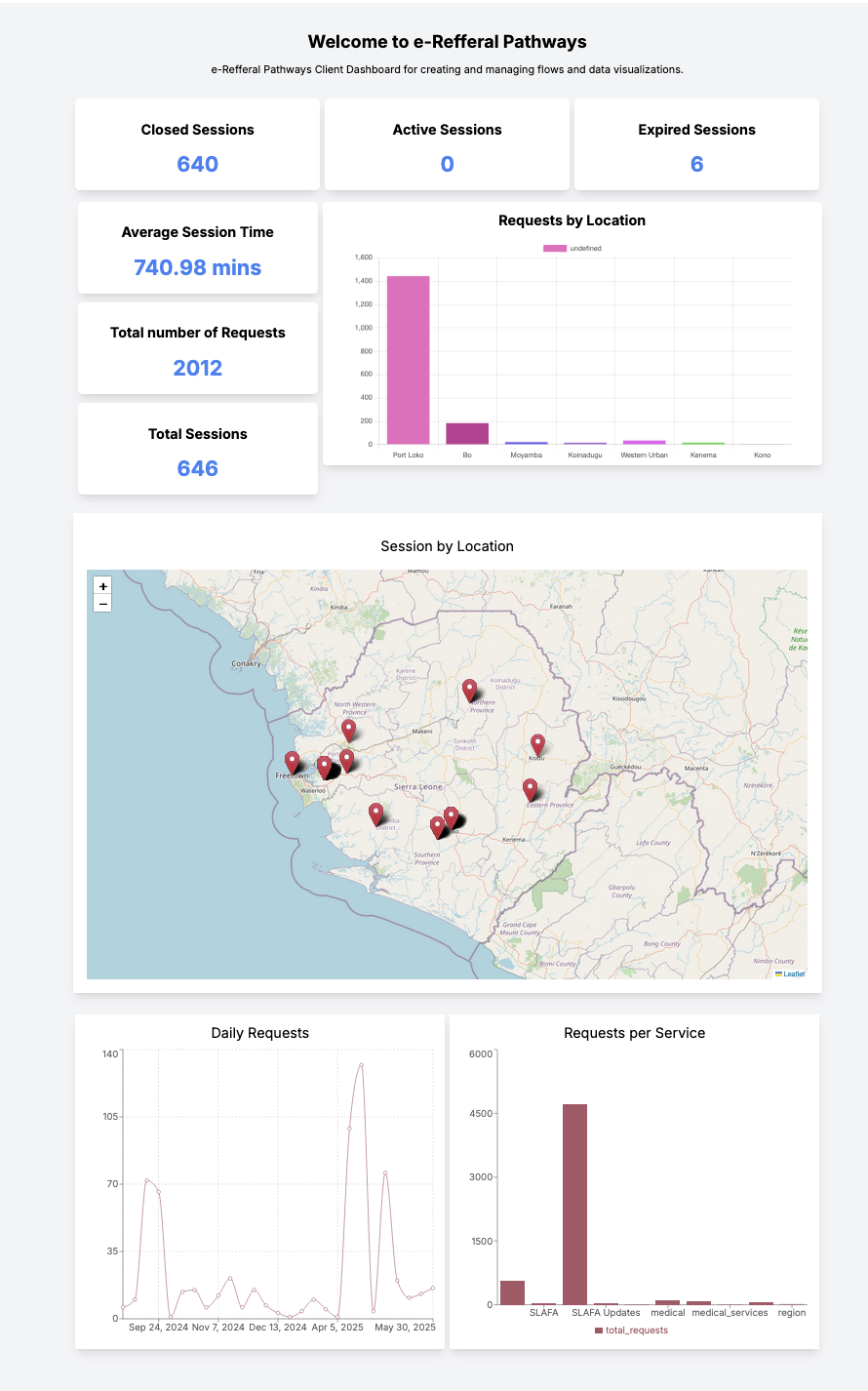
The E-Referral Pathway is a Digital Public Good (DPG) platform, collaboratively developed by UNICEF and DSTI, aimed at enhancing access to humanitarian and social welfare services for vulnerable populations in Sierra Leone. Initially a Progressive Web App, this platform is being expanded into a USSD and SMS version to improve accessibility for users with feature phones and limited internet access. This ensures women, children, and marginalized communities can connect to crucial services—including health, nutrition, education, and protection—regardless of their device or connectivity.

DPG Compliance Assessment

Detailed evaluation against Digital Public Good standards

2/9
Standards Complete

Action Required (7 remaining)

Completed Standards (2)

Overall Assessment

E-Referral Pathway demonstrates genuine SDG 3 health impact potential with real, implemented features for USSD/SMS-based health referrals. However, it has CRITICAL BLOCKERS preventing DPG approval and SERIOUS SECURITY RISKS that must be addressed before production deployment: BLOCKERS (Must fix for DPG eligibility): 1. No open source license (add Apache-2.0 or MIT immediately) 2. No clear ownership documentation (document DSTI/UNICEF roles) 3. Insufficient documentation (create comprehensive deployment and user guides) 4. No data extraction mechanism (implement CSV/JSON export) CRITICAL SECURITY ISSUES (Fix before any production use): 5. Hardcoded credentials in source code (implement secure authentication) 6. No privacy policy despite collecting health-related location data 7. Weak authentication and session management 8. No security headers, encryption, or audit logging 9. Missing harm prevention measures for health application OTHER GAPS: 10. Zero test coverage (add comprehensive testing) 11. No CI/CD automation 12. No accessibility features RECOMMENDED TIMELINE FOR DPG READINESS: PHASE 1 (Weeks 1-2) - CRITICAL: Add LICENSE, fix authentication, create privacy policy, implement basic security headers PHASE 2 (Weeks 3-4) - HIGH: Document ownership, write comprehensive README/deployment docs, add data export functionality PHASE 3 (Weeks 5-8) - MEDIUM: Implement testing (target 60% coverage), add CI/CD, improve accessibility, create API documentation PHASE 4 (Weeks 9-12) - ENHANCEMENT: Security audit, penetration testing, harm prevention measures, comprehensive user guides This project has strong foundational health impact alignment but needs significant work on licensing, documentation, security, and governance to meet DPG standards. With 6 months of dedicated effort, it can achieve DPG approval. Priority should be licensing (1 week), security fixes (2-3 weeks), and documentation (3-4 weeks) - these three areas account for most failures.

2 Complete
7 Remaining
22% Complete